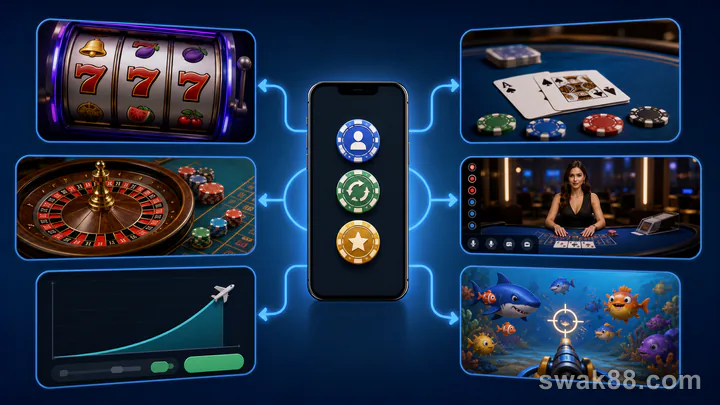
Casino play is a repeated three-step loop
Every form of casino play can be reduced to three things: you choose a stake and any allowed decisions, the game completes a defined round, and the rules settle the result. What changes across slots, table games, live dealer tables, crash games, and fishing games is when the round begins, which decisions remain available, and how visible the total cost is.
A beginner should learn one complete loop before comparing bonuses or themes. If you cannot point to the start and end of a round, it is easy to mistake animations, continuous firing, or several small bets for one low-cost action.
The six-format overview
| Format | Your input | What defines one round | How the result appears | Main control problem |
|---|---|---|---|---|
| Slots | Stake and spin | Reels stop or cascades end | Paytable evaluates symbols | Very fast repetition |
| Blackjack | Bet plus hit/stand choices | Dealer completes the hand | Hands compare to 21 | Decision quality |
| Baccarat | Player/Banker/Tie bet | Automatic drawing finishes | Two hands compare totals | Avoiding expensive side bets |
| Roulette | One or more layout bets | Ball settles in a pocket | Covered bets are paid | Seeing combined stake |
| Crash | Stake and cash-out point | Multiplier stops | Cashed-out bets win; others lose | Chasing a later exit |
| Fishing | Cannon cost and shots | Often continuous, target by target | Credits awarded on captures | Tracking ammunition spend |
Slots: the round ends when the reel sequence ends
A slot round begins when the spin is accepted and the stake is deducted. Traditional reels stop once. Cascade slots may remove winning symbols and drop new ones several times without charging another stake. The entire chain is still one paid round.
Your decisions are normally limited to total bet, manual versus autoplay, and optional features such as a bonus buy. Symbol frequency and the random result are not controlled by timing the spin button. The paytable defines which symbols, lines, ways, or clusters win.
Watch the balance through one demo round. If ₱5 is deducted once and three cascades follow, the round cost remains ₱5. If a feature buy shows 80× next to a ₱5 base stake, the feature costs ₱400. Those two interfaces may sit beside the same spin button but represent very different commitments.
Slots are easiest to operate and hardest to pace. At one spin every four seconds, fifteen rounds fit into a minute. Manual spins, a visible round counter, and a time limit make the loop easier to see.
Blackjack: the round contains several decisions
A blackjack hand starts with a wager and an initial two-card deal. You may hit, stand, double, or split when permitted. The dealer then follows fixed drawing rules. The hand ends when you bust, the dealer finishes, or split hands are settled.
The target is not simply “get 21.” You are trying to finish closer to 21 than the dealer without exceeding it. A natural blackjack—an ace plus a ten-value card on the first two cards—may pay differently from an ordinary 21, so check whether the table pays 3:2 or 6:5.
The visible stake can also change inside the round. Doubling adds a second equal wager for one final card. Splitting creates another hand with another stake. A ₱50 opening bet can therefore become ₱100 or more before settlement. Players using a ₱500 cap should reserve room for those choices rather than opening every hand at the maximum affordable unit.
Baccarat: the bet is the decision
Baccarat starts when you place a bet on Player, Banker, or Tie. The drawing procedure is automatic; the final digit of each hand total is compared. Nine is highest. A hand totaling 15 counts as 5 after the tens digit is dropped.
The main bets have simple resolution. Player wins if the Player hand is higher. Banker wins if the Banker hand is higher, usually with commission applied to a winning Banker wager. A Tie bet wins only when the totals match and normally carries a much less favorable trade-off despite the larger payout.
Roadmaps display previous outcomes, not a force determining the next hand. They can organize history but do not make a streak due to continue or reverse. For a clean first session, use one flat main bet and count hands, not patterns.
Roulette: several chips combine into one spin cost
A roulette round begins during the betting window and ends when the ball settles in a numbered pocket. Inside bets cover individual numbers or small groups. Outside bets cover broader sets such as red/black, odd/even, high/low, columns, or dozens.
Five ₱10 chips spread across the layout create a ₱50 total stake. The interface may emphasize each chip's value, so check the combined amount before the wheel spins. A winning number can settle several compatible bets, while all uncovered bets lose.
European roulette has one zero; American roulette adds double zero. The extra house pocket changes the long-run cost of standard bets without changing their familiar payouts. The wheel type therefore matters more than a recent-results board.
Live dealer: same rules, timed stream
Live dealer blackjack, baccarat, and roulette use the same core loops, but a video stream and betting timer change the experience. You have less control over pace, and a network interruption can hide part of a round without changing the server-recorded result.
Before wagering, observe a complete round. Locate the timer, history, total bet, table minimum, and result record. On Philippine mobile networks, lower the stream quality if the picture stutters while buttons remain active. Do not switch Wi-Fi and mobile data during a decision window; wait for a completed round.
If the history and balance appear out of sync after reconnection, stop placing new bets and reopen the settled-round record. A missing animation is not automatically a missing outcome.
Crash: the exit is part of the round
A crash round begins with a stake before the timer closes. A multiplier rises and then stops. Cashing out before the stop pays stake multiplied by the displayed value; failing to cash out first loses the stake.
This creates a real decision after the round starts, but it does not reveal when the stop will occur. A high previous multiplier does not guarantee an early stop next, and several early stops do not make a high run due.
Define the exit before placing the bet. If auto-cashout is available, it can enforce that choice, but it cannot turn the game positive or remove connection risk. A player who repeatedly moves the target upward during the curve has no stable plan.
Fishing games: the round may be hidden inside continuous action
Fishing games look like arcade shooters. Targets cross the screen while each shot consumes credits. Cannon levels, special weapons, or rapid fire can increase the cost per second. A captured target may award credits, but the exact relationship between target size, shot count, and capture chance is not always visible.
Treat each shot as a wager even though the screen never pauses. Set a cannon level and a shot cap before selecting a target. Continuous firing at a large creature can spend more than several table-game rounds while feeling like one chase.
This is the format where the “round” model matters most: use a short burst as your own unit, record its total cost, then pause. Do not assume a target becomes more likely to pay because it has already absorbed many shots.
A universal first-session method
Use the same seven steps across formats:
- Find the displayed total stake, not the smallest chip or coin value.
- State what event starts a round.
- List every decision that can add money before settlement.
- State exactly what ends the round.
- Watch five demo or observation rounds and measure their pace.
- Divide the session cap into at least twenty units.
- Stop at the chosen time or round count; do not reload simply because the last result was a loss.
For a broader comparison of formats and player fit, see Casino Games Online: How to Choose. For less familiar categories, the fishing, crash, and mines explainer shows how their input and settlement differ from reels and tables.
What results do—and do not—tell you
A settled result tells you what happened in that round under the posted rules. It does not prove that the same outcome is now more or less likely in the next independent round. History panels are useful for checking account records and understanding pace; they are poor prediction tools.
The practical skill is not forecasting a random result. It is seeing the full cost before input, knowing which decisions remain, recognizing the settlement, and deciding whether another round still fits the original limit.
Final checklist
Before starting casino play, you should be able to answer four questions without guessing: How much does one full round cost? Can that cost increase after the round begins? What exact event settles it? How many rounds fit the session cap at the observed pace?
If any answer is unclear, remain in demo or observation mode. Once the loop is visible, game formats become easier to compare and fast interfaces become much less confusing.
Related Reading
For a closely related guide on this site, read Casino Games Explained: How Slots, Table Games, and Live Dealer Rounds Actually Work in 2026.