Two categories most lobby guides skip entirely
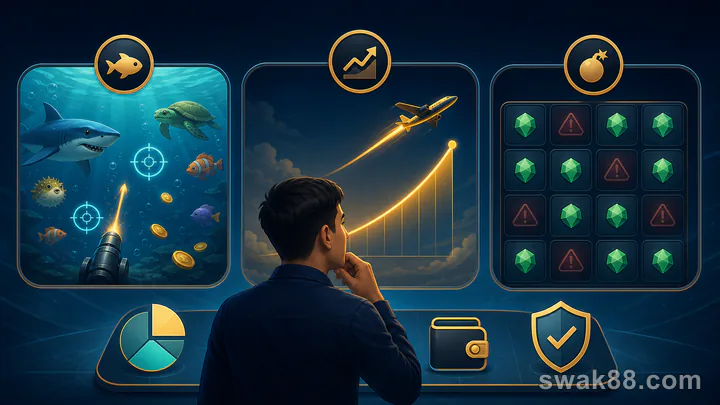
Slots, table games, and live dealer rooms are the three formats every guide covers. But open the lobby at a Philippine site and you will find two more groups sitting alongside them: fishing games, where you shoot at moving targets, and fast games — crash, mines, plinko, keno — where a round starts and finishes in seconds.
These online casino games are structured differently enough from a slot that the habits you built on reels do not transfer. The key differences are how long a round lasts, whether your input changes anything, and how the result is generated. This guide covers each, in plain terms, with no claims about what you will win.
The formats side by side
| Format | Round length | Does your input affect the outcome? | How results are set | Typical published RTP |
|---|---|---|---|---|
| Fishing games | Continuous session | Aim and timing affect which targets you hit | Random per shot, weighted by target value | 95–97% (JILI), 95–96% (Spadegaming) |
| Crash | 5–30 seconds | Yes — when you cash out | Crash point fixed before the round starts | Varies by operator; check in-game |
| Mines | Seconds, self-paced | Yes — when you stop revealing tiles | Mine positions fixed before first click | Varies; often provably fair |
| Plinko / Dice | Instant | Risk level and target selected before the drop | Random per drop | Varies; often provably fair |
| Keno | Instant | You pick the numbers | Random draw | Varies widely |
Note what the third column does and does not say. In crash and mines, your decision changes your result — but it changes when you stop, not what the game was going to do. The outcome was set before you acted. That distinction is the whole subject of the section on provable fairness below.
Fishing games: skill that moves the variance, not the edge
Fishing games are the format most associated with Philippine lobbies, and they look nothing like a casino game. You control a cannon, fire at fish crossing the screen, and each shot costs credits. Bigger and rarer targets pay more; some titles add boss encounters, combo chains, and unlockable bonuses.
The skill component is genuine but narrow. Aiming and timing determine which targets your shots are directed at, and choosing to fire at a high-value boss instead of spraying at small fish changes your risk profile for that session. What skill does not do is change the payout weighting behind each target. Every shot resolves against a random outcome weighted to the target's value, and the game's overall return sits at a level the provider sets.
Published RTP for the main studios in this category runs roughly 95–97% for JILI titles and 95–96% for Spadegaming ones. Two practical notes:
- Your credit burn rate is under your control, and it is fast. Ammunition cost per shot multiplied by shots per minute is your real stake rate, and it is far higher than one slot spin per few seconds. Check the cost-per-shot setting before you start firing.
- A high hit frequency is not a high return. These games are built around frequent small returns — reported hit frequencies around 35% in some titles — with the value concentrated in rarer targets. Landing something often is a design feature, not evidence you are ahead.
Crash: the multiplier climbs until it does not
A crash round is the simplest structure in the lobby. You place your bet before the round starts. A multiplier begins at 1.00x and rises along a curve. You can cash out at any moment to lock in your bet times the current multiplier. If the round crashes before you do, the bet is gone. Rounds typically run 5 to 30 seconds start to finish.
Most crash games offer an auto cash-out setting: you nominate a target multiplier in advance and the game exits for you when it reaches that point. This is worth using, and not for the reason people assume. It does not improve your odds. It removes the moment-to-moment decision that fast rounds are specifically designed to exploit — the hesitation at 1.8x while the number keeps climbing.
The important structural fact: the crash point for a round is determined before you place your bet. It is not calculated in response to how much has been staked or when players are cashing out. That is what the provably fair systems described below exist to demonstrate.
Mines, plinko, and dice: the provably fair family
Spribe and similar studios build a set of titles — mines, plinko, dice, and others — around instant rounds and cryptographic verification. Mines is representative: a grid of tiles hides a number of mines you set yourself, you reveal tiles one at a time with your multiplier rising per safe tile, and you cash out whenever you choose. Hit a mine and the round ends at zero.
Raising the mine count raises the per-tile multiplier and the chance of ending the round early. That is a variance dial, not an edge dial — you are choosing between many small wins and few large ones, at the same underlying return.
What "provably fair" actually proves
This term appears throughout this category and is widely misunderstood, so here is what the mechanism does, step by step:
- Before the round, the operator generates a server seed and publishes its SHA-256 hash. The hash commits to the seed without revealing it.
- Your device supplies a client seed, and the round number acts as a nonce.
- The result is computed from the combination of server seed, client seed, and nonce — meaning it was fixed before you bet.
- After the round, the server seed is revealed. You can hash it yourself and confirm it matches the hash published in step 1, then recompute the result.
The security property runs both ways: the operator commits to its seed before seeing your client seed, so it cannot tailor the outcome to your bet; you never see the server seed until the round is over, so you cannot predict the result.
What this does not prove:
- It does not remove the house edge. A provably fair game with a 3% edge still has a 3% edge, verifiably.
- It does not verify the operator's solvency or payout behaviour. Fair rounds and reliable withdrawals are separate questions — the second one comes down to licensing and track record, which is covered in our guide to how online casino sites work in the Philippines.
- It does not verify anything you do not check. The verification tool is only meaningful if you actually run it on a round.
The real risk in this category is round speed
The house edge on these formats is broadly comparable to slots. What is not comparable is how many rounds you can play per hour.
A slot spin takes a few seconds and the interface enforces a rhythm. A crash round can be re-entered immediately, a mines round takes as long as you want it to, and a fishing cannon fires continuously for as long as you hold the button. Your hourly exposure is bet size multiplied by rounds per hour, and in this category the second number can be several times higher than anything on the reels.
Practical countermeasures that do not rely on willpower:
- Set the auto cash-out target before the round rather than deciding mid-climb.
- In fishing titles, check cost per shot and set it deliberately; the default is not a neutral choice.
- Decide your session length in minutes, not in rounds. Rounds are the unit the game controls; minutes are the unit you control.
- Treat any session where you are increasing stake to recover a loss as finished, regardless of the format.
If you are still mapping the standard formats, the companion piece on how slots, table games, and live dealer rounds work covers the other three categories in the same plain terms.
Before you play a format from this group
- Find the RTP or house edge in the game's info panel — do not assume it matches slots.
- Identify what your input actually controls: usually when you stop, not what happens.
- If the game claims provable fairness, locate the verification tool before you bet, not after a loss.
- Check your per-round cost: cost per shot in fishing, base stake in crash and mines.
- Set a time limit rather than a round limit, because these formats have no natural stopping point.
None of these formats is better or worse than a slot in terms of what it returns. They are faster, they give you decisions to make, and both of those things make it easier to spend more than you planned in the same amount of time. Knowing the structure before you play is what keeps that from being a surprise.
Related Reading
For a closely related guide on this site, read Casino Frenzy Explained: Why It's Not the Same as a Real-Money Online Casino.